 Pegasus
TL;DR
- Cloud platforms allow for real-time data access across the entire showground, while desktop software traps critical information in the show office.
- Modern organisers save hours by offloading entries and payments to exhibitors through mobile technology.
- Adopting cloud horse show management reduces staff burnout and eliminates the risk of hardware failure and manual data entry errors.
Cloud horse show management uses web-based servers to store and process event data in real-time, allowing organisers to manage entries, results, and payments from any device with an internet connection. Unlike traditional desktop software that is tethered to a single hard drive, cloud-native platforms like Pegasus enable instant synchronisation between the show secretary, the in-gate, and the exhibitor's phone. This modern approach reduces manual entry errors, streamlines the check-out process, and provides a superior experience for riders, trainers, and spectators alike in every discipline from showjumping and eventing to British Dressage.
The desktop trap: The single point of failure
For decades, desktop-based software was the only tool available for equestrian show managers. These programmes lived exclusively on one hard drive, usually requiring a ruggedised laptop that never left the secretary's desk. While this software functioned without an active internet connection, it created a physical and digital bottleneck. If a trainer needed to verify a membership or check a horse's vaccination record, they had to walk to the office and wait for someone to stand in front of that specific machine.
At Pegasus, we have seen organisers struggle with what we call the single lead problem. When your show relies on localised software, your management team faces several significant hurdles:
- Manual data entry: Paper entries stacked on a desk must be manually typed into the system. This leads to typos and errors that delay the entire class schedule.
- Synchronisation issues: To make multiple computers talk to each other, you need a local server and complex networking cables. If a cable is stepped on or a network hub fails, your data gets out of sync immediately, leading to conflicting results.
- Hardware vulnerability: If the office laptop suffers a tea spill or a hard drive failure, your entire show stops. Recovering local databases mid-show is a nightmare that most managers cite as their biggest fear.
We recently discussed how modern tools solve these legacy digital issues in our guide on what is the easiest horse show software to use?.
Why is cloud horse show management better than desktop software?
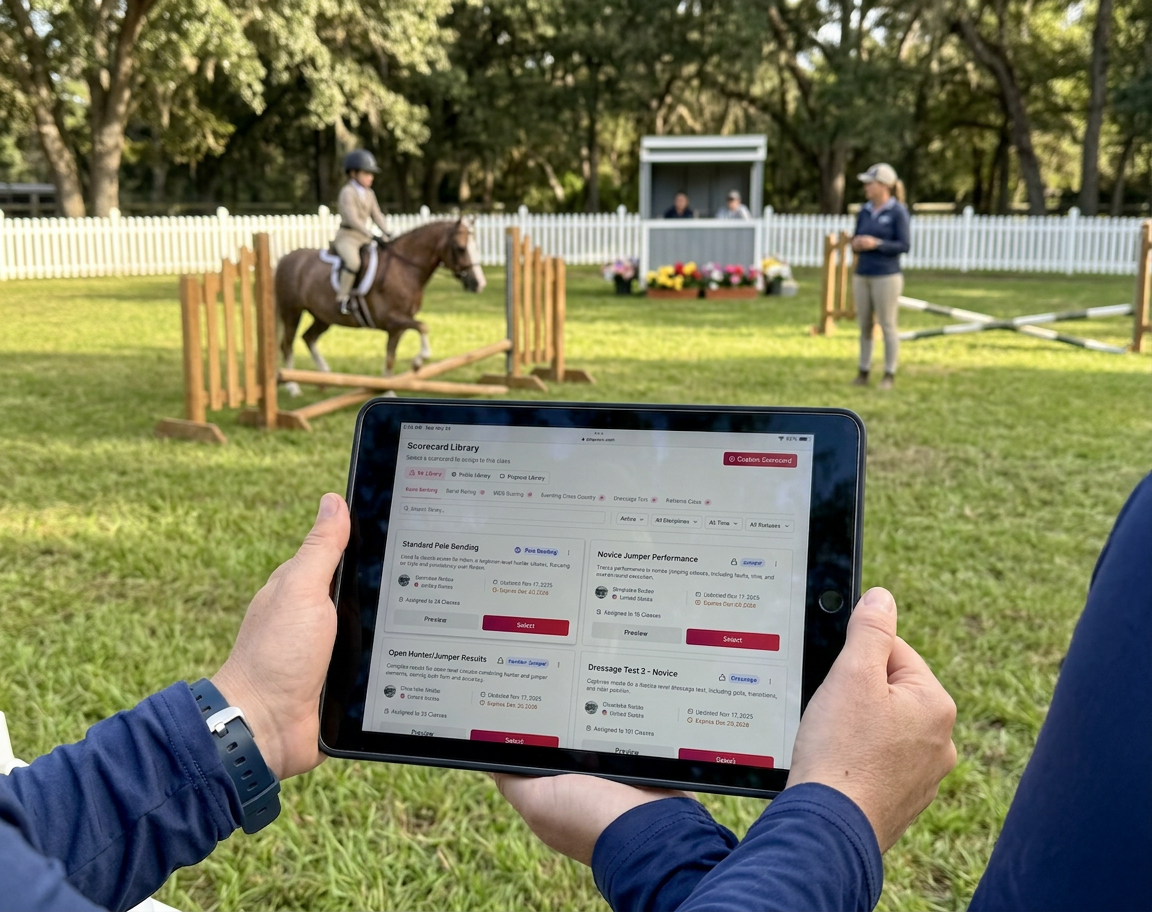
Moving to the cloud shifts your role from a data entry clerk to a high-level manager. Platforms like Pegasus operate directly in your browser, meaning the show office can now be anywhere—at the judge's box, the warm-up ring, or even your sofa at home while you prep the night before. Here is exactly where the real efficiency gains occur.
1. Eliminating manual entry workflows
With a cloud platform, the rider or owner becomes the primary data source. They handle their own online entries & payments before they even arrive at the venue. Because the system is cloud-native, you do not have to wait until you are back at the office to sync the books. The data flows directly into your dashboard. In our last show season, we saw this transition save secretaries roughly 40 percent of their pre-show workload by cutting out the paper-to-digital transcription step.
2. Real-time collaboration at the ring
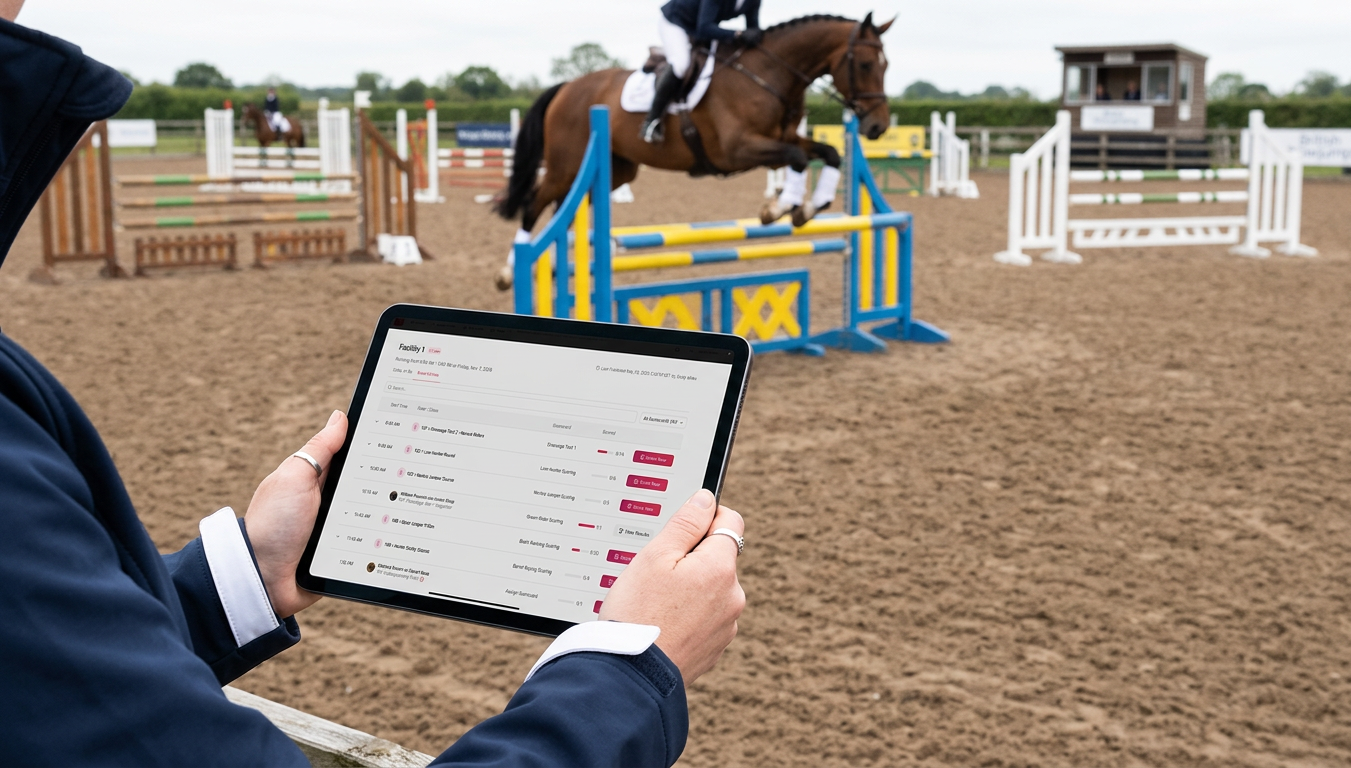
Imagine your collecting ring steward has a tablet. When they check a horse into a class or adjust the running order, it updates the office computer instantly. There is no need for a runner to carry slips of paper across the grounds. If a rider adds a class via our Show Hub, it is already on their bill before the horse clears the first fence. This is why we consider Pegasus the best horse show management system for organisers.
3. Immediate results and transparency for exhibitors
With legacy systems, the public waits for a manual export or a paper posting at the end of the day. In a cloud horse show management system, the moment the judge's card is recorded, live scoring & results are visible to everyone. This drastically reduces the number of people walking into the office just to ask when a specific class result will be posted, freeing your staff to focus on more complex logistics.
Does internet reliability still matter at UK horse shows?
This is the most common question we hear from managers at county showgrounds or remote facilities. Is a lack of Wi-Fi a dealbreaker for cloud systems? While horse shows are not always held in major tech hubs, the landscape has changed significantly over the last few years.
With high-speed satellite options like Starlink and reliable mobile hotspots, finding a facility with zero internet is now a rarity. More importantly, our observations suggest the time lost to a 10-minute internet hiccup is significantly less than the 8 to 10 hours lost over a horse show weekend to manual paper shuffling and correcting data entry errors. If you have any signal at all, the cloud is inherently faster. We have seen organisers implement these digital tools to stay competitive, even at smaller venues like local riding clubs or unaffiliated venues. You can read more about this in our post on must-have tech and trends transforming equestrian events in 2025.
Cloud vs. desktop: Which is more cost-effective?
Desktop software often requires a heavy upfront licence fee or an expensive annual support contract. You are also responsible for manual updates and IT maintenance. If your version of Windows becomes outdated, your software might stop working at the worst possible moment. Cloud software flips this model entirely. Updates happen automatically on the backend. When we release a new feature on Pegasus, it is there the next time you log in. There is no installation, and your operating system choice does not matter. For organisations looking to keep overhead low, we have analysed why Pegasus is the cheapest horse show management software in the world.
Is cloud software better for large or small shows?
You might think cloud features are only for elite BS, BD, or British Eventing fixtures, but it is actually the most efficient path for smaller local clubs as well.
- For large shows: You need the scale of stall maps & stabling and the ability to process thousands of entries without a local server crashing. You also need reports & post-show analytics to track your revenue accurately.
- For small clubs: You likely have fewer staff members. Letting the cloud handle the busy work of data validation allows a volunteer-run show to function with professional polish. We have designed specific tools to be the best horse show software for clubs to ensure they can compete with the regional championships.
The verdict: Why cloud wins for modern events
If you are running a very small show in a complete cellular dead zone and enjoy the tradition of physical file folders, desktop software still serves its purpose. It was designed for an offline era of equestrian sport. However, if you want to scale your events, reduce the burnout of your show secretary, and give your exhibitors the mobile-friendly experience they expect, cloud horse show management is the clear choice.
By allowing teams to manage class scheduling & ring management from the rail, you cut out the middleman and the stress. Pegasus was built to be the most accessible version of this future. Because it is free for organisers and runs entirely in the cloud, you can set up your next show in 30 minutes or less. Stop being tethered to the office desk and start running your show from the ring.